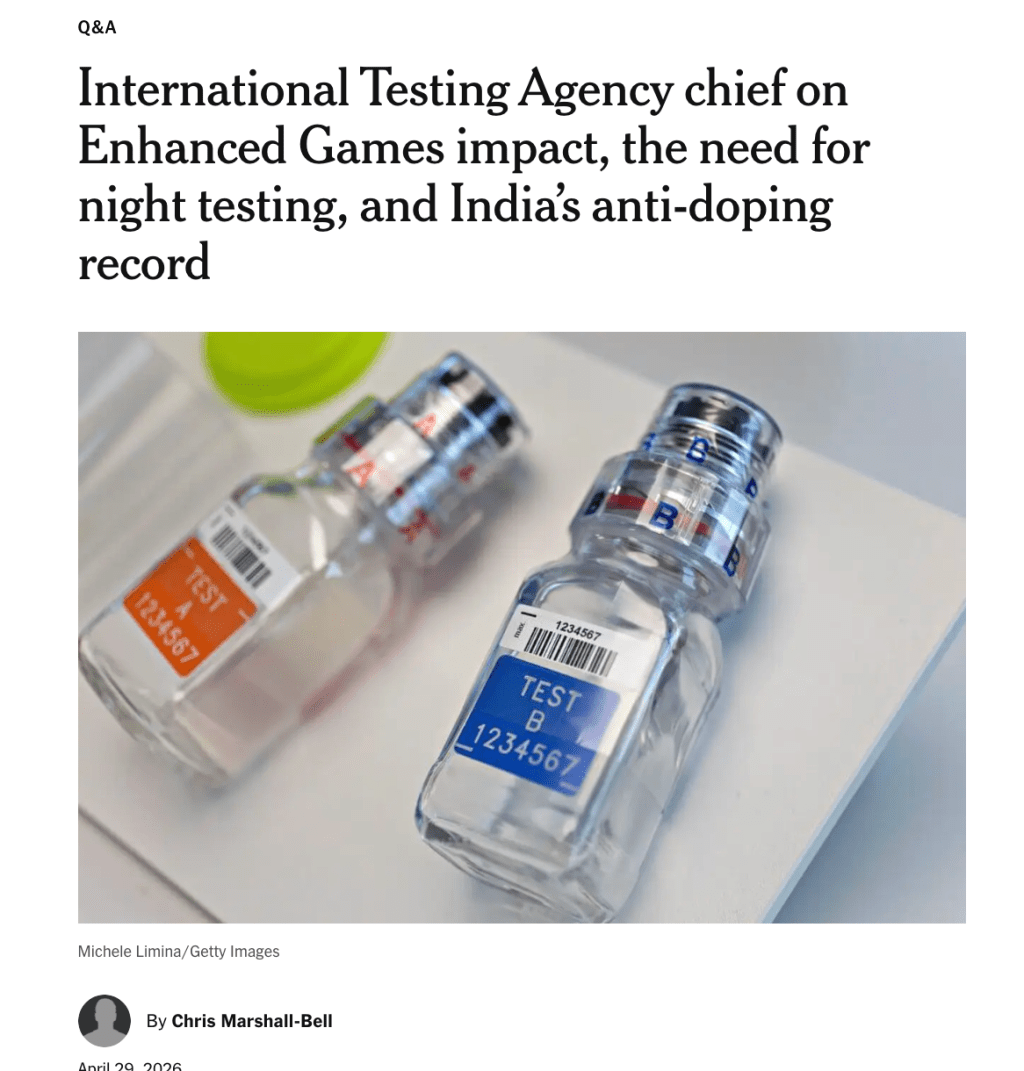
The director general of the International Testing Agency (ITA), the body that oversees anti-doping tests on behalf of the Olympic Games and over 80 international sports federations, has warned that the Enhanced Games could force a major rethink in how organisations such as his confront the fight for clean sport.
On May 24, the inaugural edition of the Enhanced Games — coined the ‘doped Olympics’ as it allows participating athletes to take performance-enhancing drugs (PEDs) under medical supervision – will take place in Las Vegas. Forty-seven athletes will compete in sprinting, short-distance swimming and weightlifting events. Any athlete who breaks an existing world record will receive $1 million in prize funds.
In February 2025, the Greek swimmer Kristian Gkolomeev was awarded $1million by the Enhanced Games after setting a time of 20.89 seconds in the 50m freestyle — breaking the previous benchmark by 0.02 seconds. World Aquatics didn’t recognise Gkolomeev’s time, and this March, Australian swimmer Cameron McEvoy set a new record time of 20.88 — faster than Gkolomeev, who swam using undisclosed prohibited substances.
That has led to discussion in some quarters that if world records are not broken at the Enhanced Games, it could cast doubt and credibility on regular sports competitions.
Speaking at the ITA’s ‘Clean Sport in Action Forum’ in Lausanne, Switzerland, Benjamin Cohen told The Athletic that he hadn’t “heard that position” but he admitted that such an outcome would pose problems for the anti-doping movement.
“I think it’s interesting if the shortcut (belief) is that if there are no world records in the Enhanced Games, that means that (athletes in) World Championships and the regular Olympics are doping as well,” Cohen said.
This article was originally published by The Athletic/New York Times in April 2026. To read the full article click here.