José Vicente is speaking to The Athletic outside his house in Alcalà de la Jovada, a hamlet of 128 people in the eastern Spanish province of Alicante. In a moment, Vicente, who is in his early 60s, will join dozens of other villagers by the side of the main road who have gathered to watch stage nine of the Vuelta a España pass through.
“With this heat and how dry it’s been, if there’s a lightning strike or if someone lights a fire, the whole hillside would go up in flames again, just like last time,” he says. “The conditions are ripe for a wildfire.”
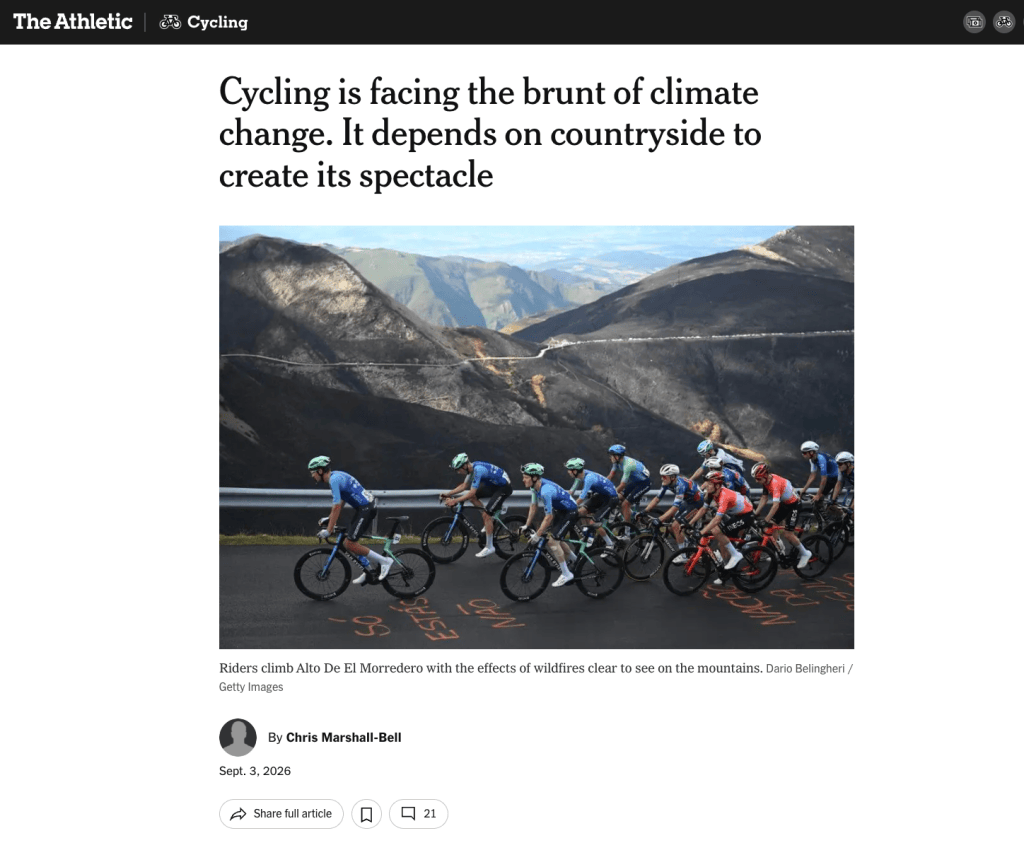
Four years ago, in mid-August, a huge wildfire — the fourth biggest of all time in the Valencia region — tore through Vall d’Ebo and Vall d’Alcalà in the Marina Alta district, incinerating forests, burning extensive swathes of farmland, and forcing the evacuation of 1,500 residents.
It is an area distinctly linked to cycling. The coastal towns of Calpe and Dénia, where every winter almost all of professional cycling’s teams are based for their pre-season training camps, are 25 miles away.
Tens of thousands of amateurs follow suit, keen to ride the same roads. The land around Puerto de Tollos and El Miserat, frequently climbed by pros and tourists alike and included in the stage nine route, was burned to the ground by the wildfire.
The Vuelta passing through this charred but slowly recovering tierra “helps to remind us all and draw attention to the tragedy of wildfires,” the Vuelta’s general director, Javier Guillén, tells The Athletic. “It highlights the need for action and for the public to be conscious of them.
“After all, these days, it’s probably the biggest problem facing Europe, and especially Spain.”
This article was published in The Athletic/New York Times during the 2026 Vuelta a España. You can read the full article here.