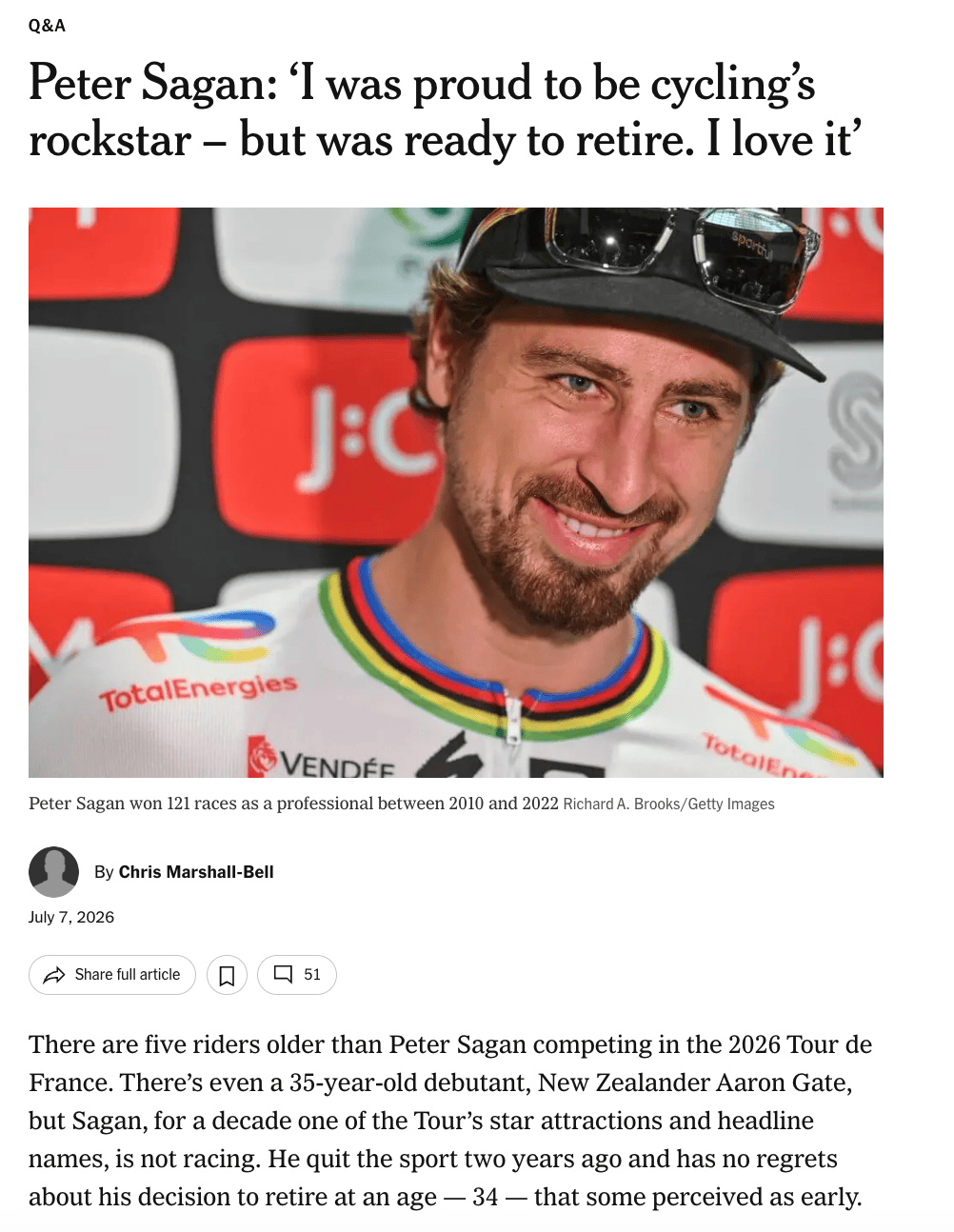
There are five riders older than Peter Sagan competing in the 2026 Tour de France. There’s even a 35-year-old debutant, New Zealander Aaron Gate, but Sagan, for a decade one of the Tour’s star attractions and headline names, is not racing. He quit the sport two years ago and has no regrets about his decision to retire at an age — 34 — that some perceived as early.
“People ask me a lot: ‘Why did you stop?’,” the Slovakian tells The Athletic three days out from the Tour, where he’s in Barcelona for an event with his longtime sponsor Sportful. “I say to them: ‘Living in this world for 14 years wasn’t enough?’ You can’t do it forever.
“When I saw the moment that I was going to be a domestique (helper) for someone, I said: ‘It’s my life. I don’t want to ride for someone and to pull the sprint for them. It’s not my style’. I said: ‘It’s enough’.”
What a sterling career Sagan drew the curtain on. A record seven green jerseys in the Tour, three successive road World Championships, and wins in Paris-Roubaix and the Tour of Flanders. There were 12 Tour stage victories, four in the Vuelta a España, and 18 in the Tour de Suisse. All in all, he was victorious as a pro 121 times. He is an eternal great.
He was much more than a bike rider. His long, wavy hair in his mid-20s was more reminiscent of a guitarist in a rock band, he tried his hand at acting in promo videos, while he would wheelie up Alpine climbs and bunny hop to avoid crashes — or simply because he was bored.
In a sport where media shyness is the norm, Sagan stood out for being different. He was an icon for many, a fan favourite to most, and Slovakia’s biggest representative on the international stage.
“I am proud of having the nickname ‘The Rockstar’ because nobody else was called that in cycling before,” he says.
But all of that attention came with its drawbacks. Pressure, fame and fatigue took its toll.
This article was published by The Athletic in July 2026. To read the full article click here.