
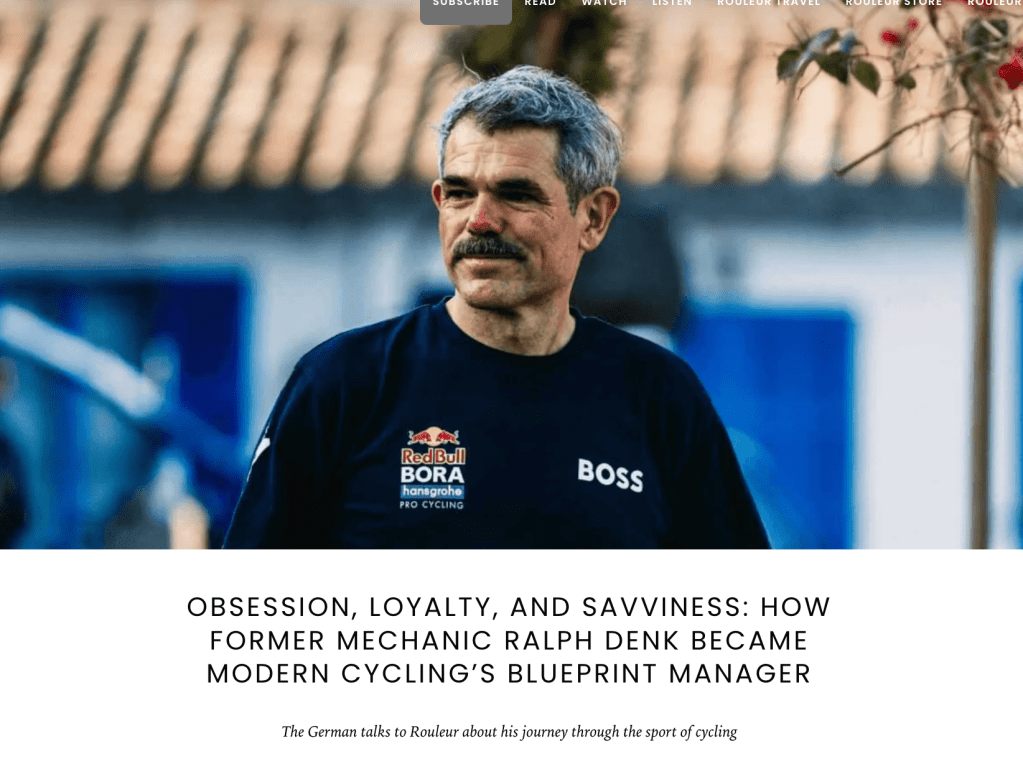
Patrick Lefevere recently claimed that “I hate Ralph Denk”, a statement entirely in keeping with Lefevere’s boisterous, opinionated tendencies that made him this century’s most recognisable (and controversial, as well as successful) cycling manager before his retirement just over a year ago. Within that heavy-hitting statement there was something far more meaningful and significant than one man’s dislike of a peer: it was an acceptance that a former ski racing junior whose first job was getting his hands dirty cleaning mountain bikes is now established as one of sport’s most instrumental and influential figures.
Lefevere’s comments were in relation to how Denk managed to persuade Remco Evenepoel – the last great prodigy out of the long Lefevere lineage – to leave his Soudal Quick-Step contract prematurely to join Denk’s growing project at Red Bull-Bora-Hansgrohe, a venture that has its roots in a small mountain bike team that became the best in the world, and then reinvented itself into as a start-up Continental team that a decade-and-a-half later attracted the interest of the sporting world’s most marketable company.
The Lefevere era has departed, and a new era marked by Denk and his contemporaries is promising to change the structure of cycling forever. “My dream is to win the Tour de France, but my other dream is to make the cake bigger, to create a time when the 49% share that I now own becomes real value,” says Denk, 52.
This article was published by Rouleur in February 2026. You can read the full article here.
 CMB reports