
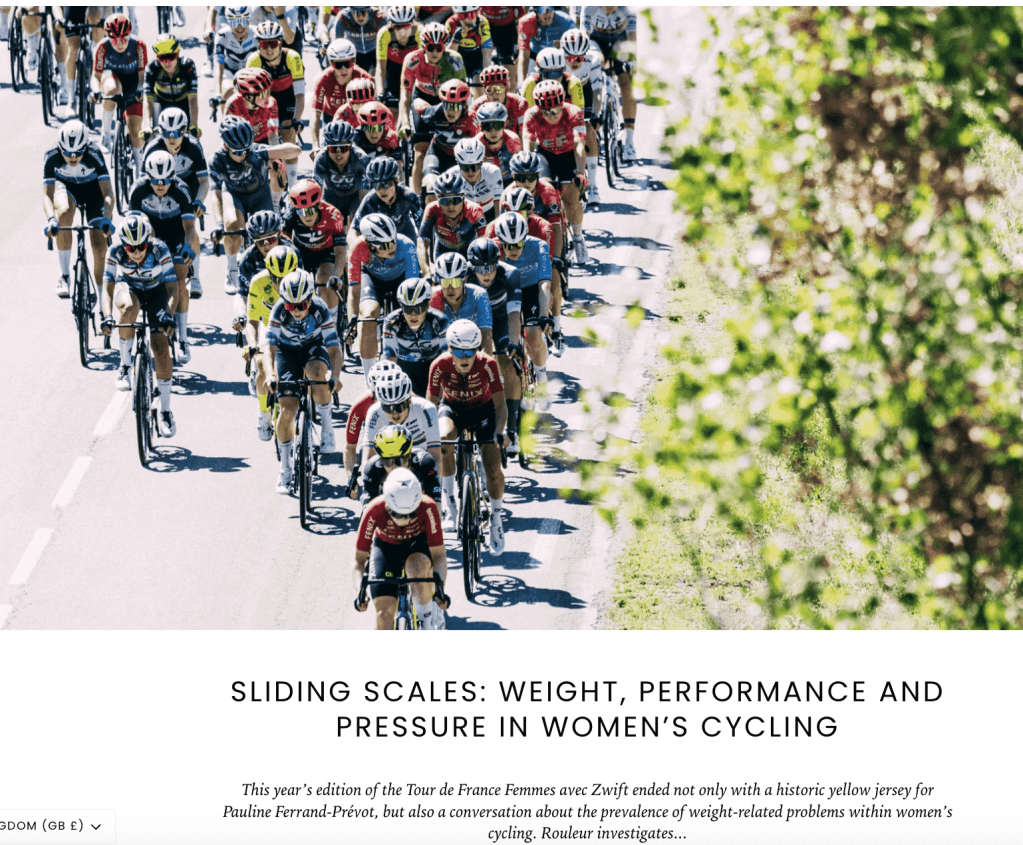
Pauline Ferrand-Prévot hadn’t even left the cosy Alpine resort town of Châtel, the place where she made sure of her dominant Tour de France Femmes victory, when a fervent debate about her weight threatened to overshadow her latest career triumph.
“We secretly hoped that she wouldn’t be successful,” said Marlen Reusser – a rival who had hoped to challenge for the yellow jersey only to abandon on day one due to illness. “Ferrand-Prévot has set a new standard,” Reusser continued. “When riders are this successful by becoming so thin, it puts pressure on all of us. What’s the takeaway for a 17-year-old without a nutritionist seeing this kind of body ideal being celebrated?” Demi Vollering, who finished second to Ferrand-Prévot, added: “I just really hope that young girls don’t now think they need to be super skinny to ride in the mountains.”
The ‘crime’ was that Ferrand-Prévot, perhaps the greatest multidisciplinarian in the sport’s history, had lost four kilograms of weight between winning Paris-Roubaix in April and triumphing on her debut at the Tour in August. The Frenchwoman herself said, “I don’t want to stay like this – I know it’s not 100 per cent healthy”, but defended her practice, stating that her weight loss was a calculated and controlled short-term reduction to help her in the high mountains to win the Tour and that it was not something she planned to maintain long term.
But the discussion around weight and disordered eating in the sport has not gone away – instead, the conversation surrounding Ferrand-Prévot has served to highlight the issue and bring it into sharper focus. Many are now asking openly: how many athletes in the men’s and women’s pelotons struggle with their weight? Was what Ferrand-Prévot did really as damaging to her own body as some made out, and did it set a dangerous precedent to both her fellow competitors and impressionable followers of the sport? Or is it just an unavoidable part of trying to win a Grand Tour in professional cycling?
This article was published in Rouleur magazine in December 2025. You can read the full article here.


 CMB reports