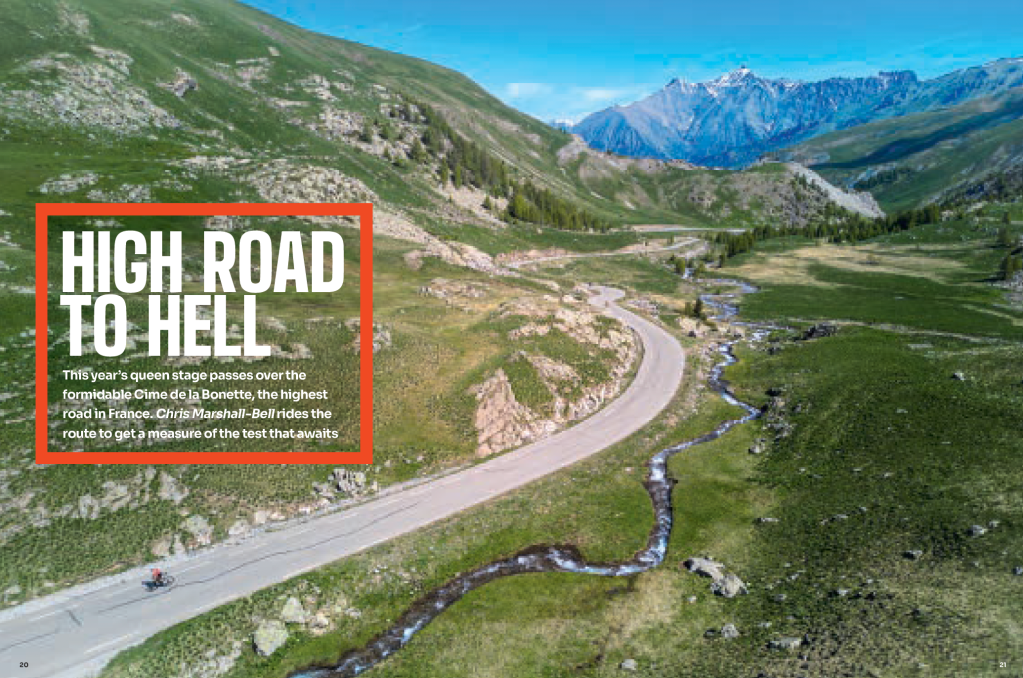
“When you’re racing on the Bonette, you don’t think it’s beautiful; you hate it. It’s terrible, really terrible,” says Bjarne Riis, the disputed ‘winner’ of the 1996 Tour. “If you want to admire the beauty, go there for a training ride and stop to enjoy the view. But in a race it’s tough – so very tough. It’s long, it’s at high altitude, and it’s up there with one of the hardest climbs in cycling.”
During the 2024 Tour de France’s stage 19, the Tour de France is returning to the roof of the world: the Cime de la Bonette. The highest paved through-road in Europe – though not the highest road on the Continent, which is Spain’s Pico Veleta (3,398m) – the Tour will go up and over the 2,802m peak for only the fifth time, and just the second time this century. Sandwiched in between two further 2,000m-plus climbs, the Col de Vars and Isola 2000, it’s a queen stage befitting of its royal title.
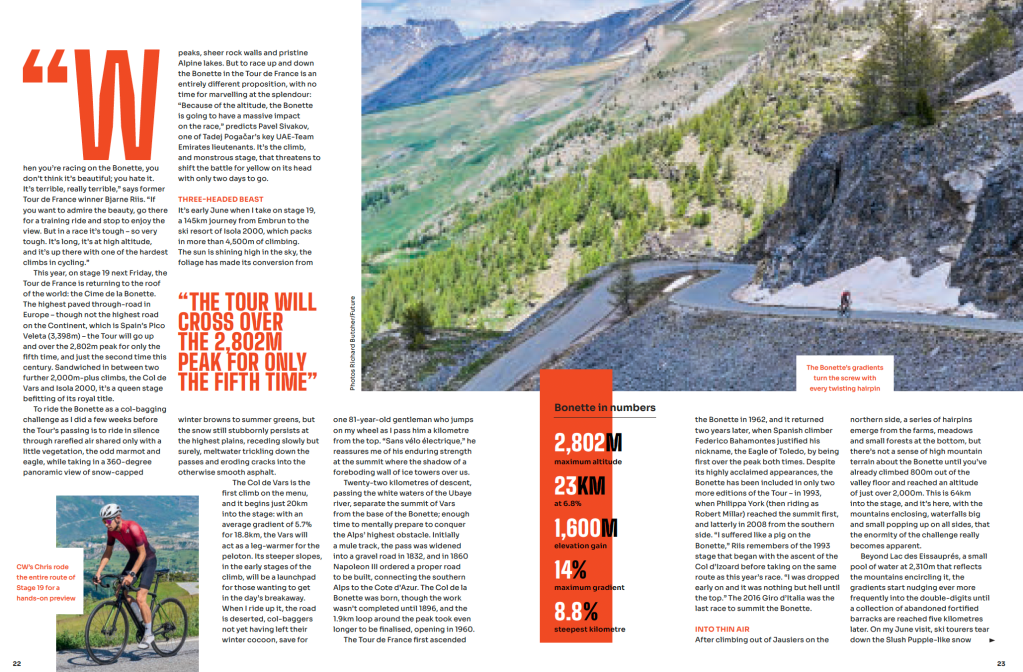
To ride the Bonette as a col-bagging challenge as I did a few weeks before the Tour’s passing is to ride in silence through rarefied air shared only with a little vegetation, the odd marmot and eagle, while taking in a 360-degree panoramic view of snow-capped peaks, sheer rock walls and pristine Alpine lakes. But to race up and down the Bonette in the Tour de France is an entirely different proposition, with no time for marvelling at the splendour: “Because of the altitude, the Bonette is going to have a massive impact on the race,” predicts Pavel Sivakov, one of Tadej Pogačar’s key UAE-Team Emirates lieutenants. It’s the climb, and monstrous stage, that threatens to shift the battle for yellow on its head with only two days to go.
It’s early June when I take on stage 19, a 145km journey from Embrun to the ski resort of Isola 2000, which packs in more than 4,500m of climbing. The sun is shining high in the sky, the foliage has made its conversion from winter browns to summer greens, but the snow still stubbornly persists at the highest plains, receding slowly but surely, meltwater trickling down the passes and eroding cracks into the otherwise smooth asphalt.
This article was published in Cycling Weekly in July 2024. Read the full article here.