
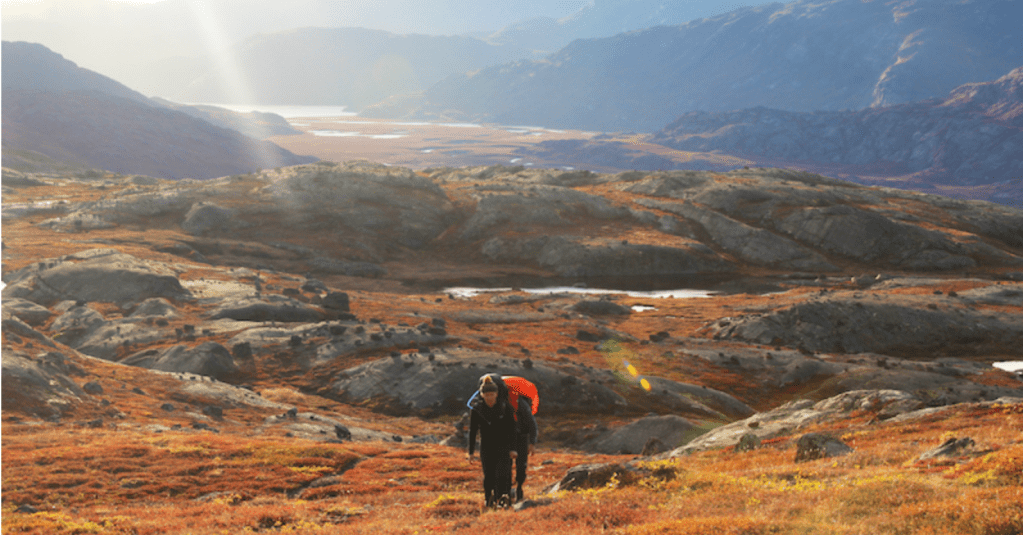
Wiping the sweat off my brow and panting in exhaustion, I took my backpack off – a brief respite from hauling a week’s worth of food and essentials – and sat down on a large boulder to survey the landscape. Beneath me, Mitchell and Simon struggled up the hill, out of the tundra and into the lunar-esque landscape.
To my right, in the distance, I could see the world’s second largest permanent ice cap; in front me sat a bowl-shaped valley, populated by dozens of lakes – some paddling pool-sized, some reservoir-sized – and fortified by ancient rock faces that sharply rose from the heathland.
And to my left, out of sight for the time-being and beyond more undulations and lakes, was a little red wooden hut, that night’s resting place. Above, the sun radiated its glow onto the autumnal colours of the tundra and struck a golden shine across the sky.
The remoteness, the wilderness and the beauty held me spellbound.
The isolation didn’t need reinforcing – indeed, few animals even reside in these parts – but Simon delivered it, the inner-climber in him invigorated. “That’d be a nice gully to climb up in the winter,” he proclaimed, pointing away to his right.
“How many pitches, do you reckon?” I asked.
“Three, four. Don’t know.”
No one probably knows.
No person has probably ever even stood at the top of the mountain in question, that’s how remote this part of the world is. The mountains are nameless. The lakes, too. Likewise the valleys and gorges.
It was day five on the Arctic Circle Trail in west Greenland, a 102-mile self-sufficient hike, and just like the preceding four days, all around us was virgin, untamed land. And it was enchanting.
This article was published in Wired for Adventure in June 2017. You can read the full article here.


 CMB reports